“Thy will be done.” When Jesus prayed these words in Gethsemane, the church came to read them as clear evidence that the incarnate Son has two wills: the divine will he shares eternally with the Father and Spirit, and a true human will he took on for our salvation. The Third Council of Constantinople (680-81) made this dyothelite teaching part of the church’s confession, and it was accepted East and West and by the Reformation churches. In recent decades, though, a number of theologians and Christian philosophers have argued that Christ has only one will, on the grounds that this better protects the unity of his person.
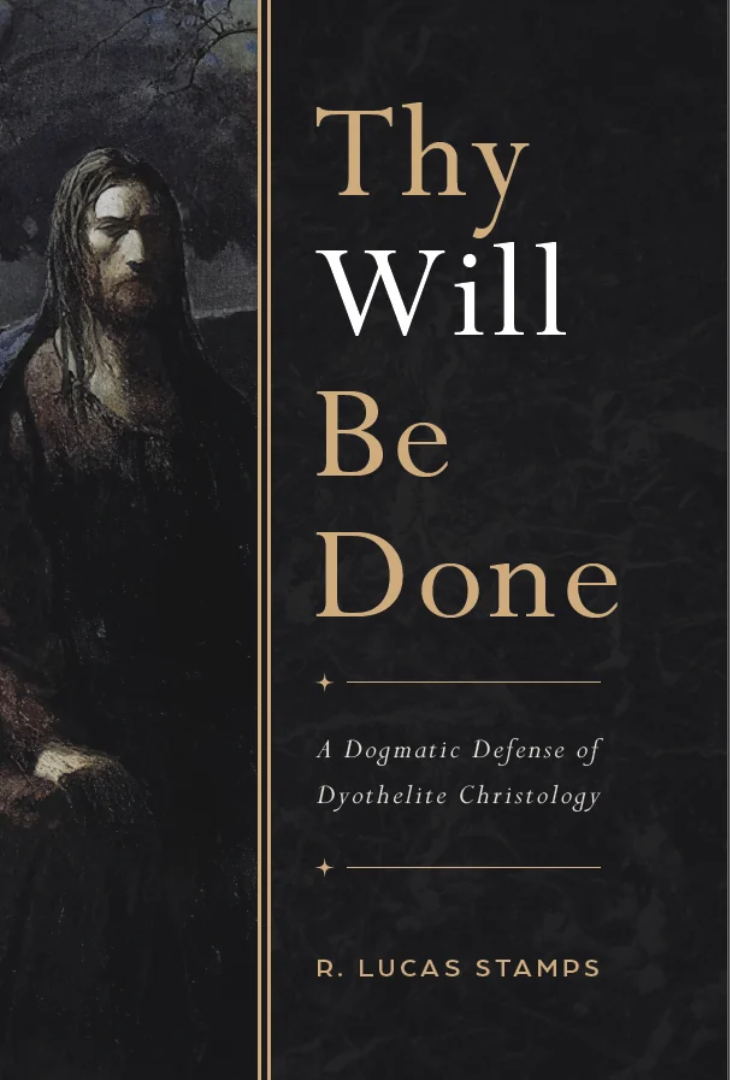
Thy Will Be Done is a thorough dogmatic defense of the two-wills position. R. Lucas Stamps begins by setting out and critiquing three overlapping kinds of contemporary monothelitism: abstractist, kenotic, and Spirit Christologies. He then recovers the dyothelite consensus of the patristic and medieval church, from Maximus the Confessor and John of Damascus to Thomas Aquinas, and follows how it was carried into Reformed Christology through John Calvin, John Gill, W. G. T. Shedd, and Thomas F. Torrance. The final chapter builds a contemporary dyothelite Christology from Scripture, including the Gethsemane narrative, John 6, and Hebrews 10, and shows what is at stake for Christology, the Trinity, and soteriology. The book argues that monothelitism creates more problems than it solves, and that theologians today have good reason not to move the ancient dyothelite landmark.
R. Lucas Stamps (PhD, The Southern Baptist Theological Seminary) serves as Professor of Christian Theology and Director of the Masters Programs at Clamp Divinity School, Anderson University (SC). He also serves on the board of directors for the Center for Baptist Renewal.
Generous, rigorous, biblical, theological, and practical: any work that embodies these virtues is worthy of the reader’s time and attention. Such is the latest offering from Luke Stamps. Addressing a doctrine that is often misunderstood, neglected, or poorly explained, Stamps proves a sure and trustworthy guide. With remarkable clarity, he navigates theological cul-de-sacs and philosophical conundrums like a theological Odysseus steering safely between Scylla and Charybdis. Insightful and judicious throughout, Stamps is always engaging and always edifying.
–Rev. Dr. Myk Habets, Director of Research
Laidlaw College
We have waited a long time for this helpful monograph that rehabilitates the two-wills view of the incarnation. Stamps firmly but respectfully reminds moderns that dyotheletism has been the considered opinion of the great Christian tradition: “the right answer” on the history of doctrine test, as it were. But he builds his own case primarily by appeal to systematic coherence, with a steady eye on the biblical foundations. Clearly written and patiently argued, Stamps’ discussion brings tremendous light to a difficult subject.
–Fred Sanders, Research Professor of Theology in the Torrey Honors College at Biola University
Description
“Thy will be done.” When Jesus prayed these words in Gethsemane, the church came to read them as clear evidence that the incarnate Son has two wills: the divine will he shares eternally with the Father and Spirit, and a true human will he took on for our salvation. The Third Council of Constantinople (680-81) made this dyothelite teaching part of the church’s confession, and it was accepted East and West and by the Reformation churches. In recent decades, though, a number of theologians and Christian philosophers have argued that Christ has only one will, on the grounds that this better protects the unity of his person.
Thy Will Be Done is a thorough dogmatic defense of the two-wills position. R. Lucas Stamps begins by setting out and critiquing three overlapping kinds of contemporary monothelitism: abstractist, kenotic, and Spirit Christologies. He then recovers the dyothelite consensus of the patristic and medieval church, from Maximus the Confessor and John of Damascus to Thomas Aquinas, and follows how it was carried into Reformed Christology through John Calvin, John Gill, W. G. T. Shedd, and Thomas F. Torrance. The final chapter builds a contemporary dyothelite Christology from Scripture, including the Gethsemane narrative, John 6, and Hebrews 10, and shows what is at stake for Christology, the Trinity, and soteriology. The book argues that monothelitism creates more problems than it solves, and that theologians today have good reason not to move the ancient dyothelite landmark.
PAPERBACK| 6 X 9 | PUBLISHED December 1, 2026 | ISBN 979-8-9958395-2-1 | Library of Congress Control Number: 2026926956



Reviews
There are no reviews yet.